Building a mobile app in the UAE: native vs React Native vs Flutter
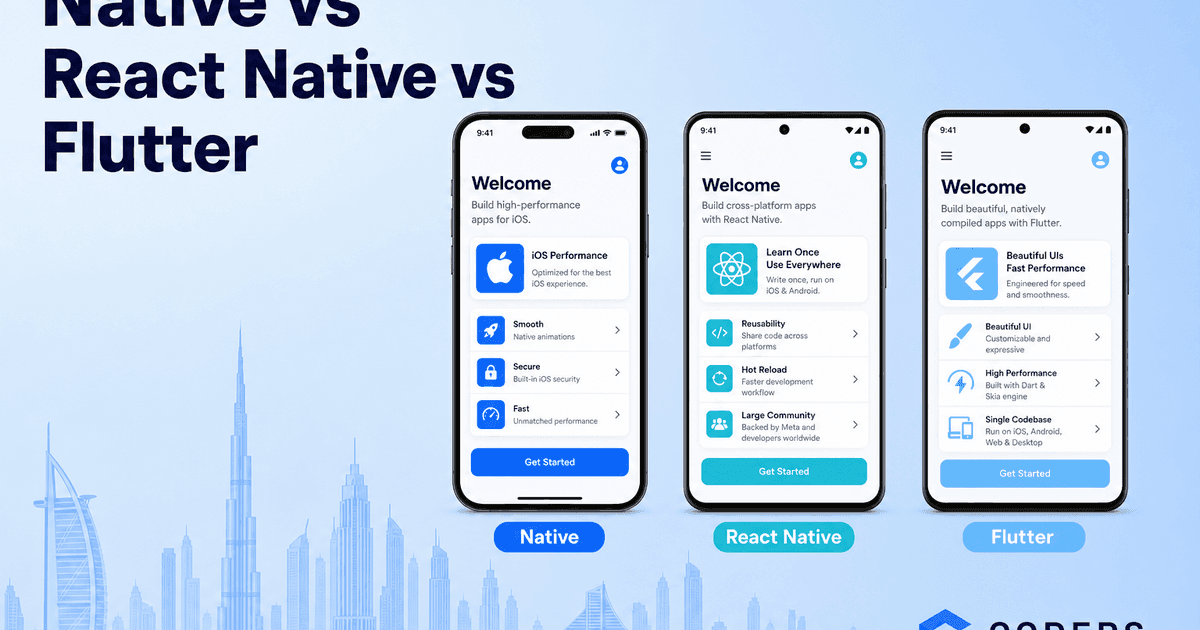
If you are building a mobile app in the UAE, one of the first decisions is also one of the most consequential: native iOS and Android, or cross-platform with React Native or Flutter? The wrong choice can cost you weeks of work, six figures of rebuild, or a product that feels broken to users. Here is how to choose.
The 30-second answer
- Pick React Native if you want one team, one codebase, and a fast path to launching on both iOS and Android. Great for most UAE startups and SMEs.
- Pick Flutter if your app is design-heavy, custom animation-heavy, or you want a perfectly consistent UI across platforms.
- Pick native (Swift / Kotlin) if you need deep platform integration, demanding graphics, large existing native teams, or you are building for the App Store premium tier.
What the three options actually are
Native (Swift for iOS, Kotlin for Android)
You write two apps in two languages with two teams. The result: maximum performance, full access to every platform API the moment Apple or Google ships it, and the most "native" feel. Trade-off: typically 70 to 100 percent more cost than a single cross-platform codebase, and slower to iterate.
React Native
A JavaScript framework from Meta that renders real native components. Your developers write React, and React Native translates UI to native UIView and ViewGroup objects. Used by Discord, Shopify, Coinbase, Microsoft, and the Facebook app itself.
Flutter
A Dart-based framework from Google that does not use native UI components - it draws every pixel itself using a custom rendering engine (Impeller). Used by Google Pay, BMW, Alibaba, and ByteDance products. The big upside is pixel-perfect consistency; the big downside is that the app does not always feel native.
Comparison table for UAE teams
| Criterion | Native | React Native | Flutter |
|---|---|---|---|
| Cost to first launch | High | Low to medium | Low to medium |
| Time to launch (typical MVP) | 14 to 20 weeks | 8 to 14 weeks | 8 to 14 weeks |
| Talent pool in UAE | Moderate, expensive | Large | Smaller but growing |
| Performance | Best | Very good | Excellent |
| Native feel on iOS | Best | Very good | Good (custom drawn) |
| Native feel on Android | Best | Very good | Very good |
| Access to new platform features | Day one | Few weeks to months | Few weeks to months |
| Code reuse | 0 percent | 80 to 95 percent | 90 to 98 percent |
| Long-term maintenance cost | Highest | Moderate | Moderate |
| Heavy graphics or AR | Best | Plugin-dependent | Possible but limited |
When native is the right call
Choose native when at least one of these is true.
- You are building a game or a graphics-heavy app (AR, 3D, video editing). Use SceneKit, Metal, or Vulkan directly.
- You need deep integration with iOS or Android features that lag in cross-platform frameworks (CarPlay, HomeKit, Wear OS, Android Auto, Apple Vision Pro).
- You already have a strong native team and a large existing native codebase.
- Your customers are highly demanding about UI feel and consistency with the OS - typically luxury or premium consumer apps.
- You can afford 70 to 100 percent more budget and timeline.
When React Native is the right call
Pick React Native when:
- You want a single codebase shipping to both stores.
- Your team already has React or web skills.
- You need to ship MVP fast and validate the market.
- Most of your screens are standard UI patterns (forms, lists, navigation, modals).
- You expect to share logic with a web product.
React Native in 2026 is a much safer bet than it was 3 years ago. The new architecture (Fabric and TurboModules), Expo's expanding capabilities, and React 19 / RN 0.76+ give it near-native performance for most apps.
When Flutter is the right call
Pick Flutter when:
- You want one codebase but with pixel-perfect identical UI on both platforms.
- Custom motion, animations, and branding are core to your product.
- Your team is comfortable with Dart (or willing to learn).
- You want desktop or web compilation later from the same codebase.
Flutter is the best choice for apps where the UI itself is a differentiator (consumer brand, content app, gamified experience). It is less ideal for apps that need to feel like "just a normal iOS app" or rely on lots of system-native dialogs and patterns.
What UAE-specific factors should you consider?
App store and developer accounts
- Apple Developer Program: USD 99 per year (about AED 365), required for App Store.
- Google Play Console: USD 25 one-time (about AED 92).
- Set up under your company name with your UAE Trade Licence.
Payments
- Apple and Google take 15 to 30 percent of in-app purchases.
- For physical goods and services, integrate Stripe, Telr, Network International, Tabby, or Tamara directly - no Apple/Google cut.
Languages and RTL
If you need Arabic support, all three frameworks handle RTL well in 2026. React Native and Flutter need slightly more care for mixed-direction layouts (English numbers in Arabic sentences).
Compliance
If you handle UAE health, finance, or government data, check UAE Personal Data Protection Law (PDPL) requirements. This affects analytics, crash reporting, and any third-party SDK you bundle.
Notification deliverability in the UAE
WhatsApp Business API, Firebase Cloud Messaging, and APNS all work well in the UAE. SMS through providers like Twilio or local UAE telcos requires sender ID registration with the TRA (now TDRA).
Cost ranges in the UAE in 2026
| Stage | Native (both platforms) | React Native | Flutter |
|---|---|---|---|
| MVP (10 to 15 screens) | AED 120,000 - 220,000 | AED 60,000 - 110,000 | AED 60,000 - 110,000 |
| Mid-complexity app | AED 220,000 - 450,000 | AED 110,000 - 250,000 | AED 110,000 - 250,000 |
| Complex app with backend | AED 400,000 - 800,000+ | AED 200,000 - 500,000 | AED 200,000 - 500,000 |
| Annual maintenance | 15 to 25 percent of build | 10 to 18 percent of build | 10 to 18 percent of build |
Backend, hosting, and ongoing infrastructure are extra in all cases.
A practical recommendation
For most UAE startups and SMEs in 2026, React Native is the default. It hits the sweet spot of cost, speed, talent availability, and "good enough" platform feel. You can always rebuild a specific screen in native later if you hit a wall.
Choose Flutter when design is your competitive advantage. Choose native when performance, platform depth, or premium polish is non-negotiable.
Frequently asked questions
Can I publish a React Native or Flutter app to the App Store?
Yes, both produce real iOS apps that ship to the App Store and Google Play. The review process is identical to native.
Is React Native dying?
No. The new architecture rollout in late 2024 and 2025 has made it faster and more stable than ever. Major apps including Shopify, Discord, and the Facebook family of apps continue to invest in it.
Do users notice the difference?
In 2026, for the vast majority of apps, no. The biggest visible gaps are in custom animations and platform-native UI affordances (sheet presentations, system menus). For business apps, productivity apps, and most consumer apps, users cannot tell.
How long to go from idea to App Store with React Native?
For a simple MVP, 8 to 12 weeks. For a polished consumer app with backend, payments, and notifications, 14 to 20 weeks.
Key takeaways
- React Native is the default choice for most UAE businesses in 2026.
- Flutter wins for design-first apps where consistency and motion matter most.
- Native is for performance-critical or platform-deep apps where budget is not the constraint.
- Cross-platform saves 40 to 60 percent on initial build cost.
- The right choice depends more on your team and your product than on the technology.
Building a mobile app in the UAE? Call Coders Technologies on +971 50 403 6906 or read more on our mobile development page.
Want help with this in your business?
Talk to our team. We design, build, and run IT and AI solutions for UAE businesses.
More from the blog
How much does it cost to develop a mobile app in Dubai in 2026?
Real starting-from prices for mobile app development in Dubai, what actually drives the cost, the expenses most quotes leave out, and how to spot a bad quote.
Power BI vs Tableau in the UAE: which BI tool for your business in 2026?
Power BI or Tableau for a UAE business in 2026? A practical comparison of cost, integration, and depth, plus the custom-dashboard option and why data prep decides it.

How to choose a software development company in the UAE: a 2026 checklist
A practical 2026 checklist for choosing a UAE software company: code ownership, verifying the portfolio, local fit, pricing traps, and de-risking with a small first phase.