What is an AI agent and how UAE businesses are using them in 2026
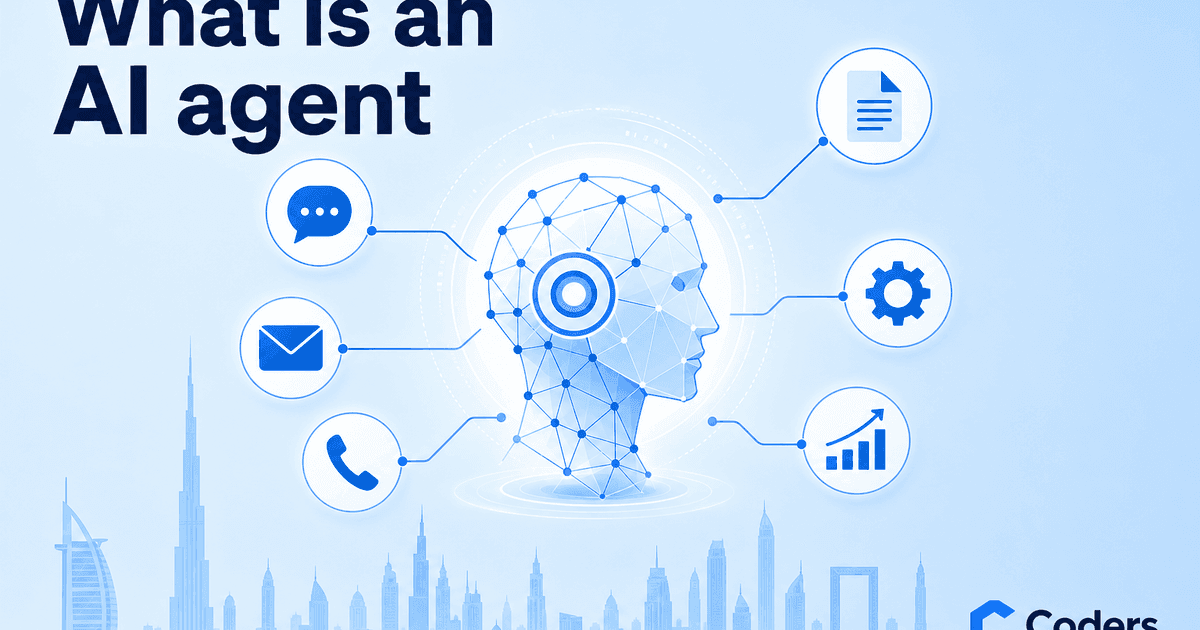
An AI agent is a software system that uses a large language model (LLM) to make decisions, call tools, and take actions to complete a task on behalf of a user. Unlike a normal chatbot that only replies to messages, an agent can read a database, send emails, book meetings, query APIs, write reports, and chain multiple steps together autonomously. In 2026, UAE businesses are using AI agents to cut operating costs, scale customer support, and replace repetitive office work.
Agent vs chatbot vs automation: what is the difference?
| Type | What it does | Example |
|---|---|---|
| Chatbot | Replies to text or voice using rules or an LLM | "What are your opening hours?" |
| RPA / automation | Follows a fixed script across apps | "Every Monday, export sales report to CSV and email it" |
| AI agent | Uses an LLM to plan, decide, and call tools to reach a goal | "Find me 5 cafe leads in JLT and email each one a tailored introduction" |
The key difference: an agent can handle ambiguity. You describe the goal, the agent figures out the steps.
How an AI agent works under the hood
- A goal arrives from a user, a webhook, a schedule, or another agent.
- The LLM plans the steps to reach the goal based on the tools it can use.
- The agent calls a tool (an API, a database query, a function in your code).
- It reads the result, decides if the goal is complete, and either responds or loops back to step 2.
- Guardrails monitor every step: token limits, content checks, action approval for risky operations.
A modern agent stack typically includes:
- An LLM (OpenAI GPT-4 / GPT-5, Anthropic Claude, Meta Llama, etc.)
- A tools layer (function calling, MCP servers, API connectors)
- Memory (short-term context, long-term vector store)
- A control loop (LangGraph, LlamaIndex, custom)
- Observability (logs, traces, evals)
- Guardrails (PII scrubbing, action approvals, kill switch)
What UAE businesses are using AI agents for in 2026
We work with companies across the UAE. Here are real categories we have shipped agents for.
1. Customer support agents
A bilingual (Arabic and English) WhatsApp or web chat agent that handles 60 to 85 percent of tier-1 questions for an e-commerce store, real estate brokerage, or clinic. Hands off complex cases to humans with full context.
Typical impact: 40 to 70 percent reduction in tier-1 ticket volume, 24/7 coverage without night-shift cost.
2. Sales prospecting and outreach agents
An agent that researches a list of companies, finds the right decision maker, drafts a tailored intro, and queues it in the sales team's CRM for one-click approval. Useful for B2B firms targeting SMEs across the UAE and GCC.
Typical impact: 5 to 10x more qualified outreach per BD person per week.
3. Internal knowledge agents
A private agent that knows your SOPs, contracts, product catalogue, and internal wikis. Staff ask in natural language ("what is our refund policy for corporate clients?") and get the right answer with sources.
Typical impact: 30 to 60 percent reduction in time spent finding internal information.
4. Operations and back-office agents
Agents that read incoming emails, extract structured data (invoice details, order requests, RFPs), classify them, and route them into the right system (ERP, accounting software, ticketing tool).
Typical impact: 70 to 90 percent reduction in manual data entry.
5. Content and reporting agents
An agent that pulls KPIs from your analytics, marketing, and finance systems every Sunday, writes a 1-page executive summary, and emails it to leadership. Or one that drafts blog posts, social posts, and ad creative grounded in your brand voice.
Typical impact: 60 to 80 percent of first-draft time saved.
6. Voice agents
Phone-based agents that take orders, book appointments, qualify leads, or follow up on collections. UAE clinics, restaurants, and service businesses are early adopters.
Typical impact: 20 to 50 percent of inbound calls fully handled without staff.
How much do AI agents cost in the UAE?
| Tier | Description | Build cost (AED) | Monthly running cost (AED) |
|---|---|---|---|
| Pilot | Single use case, simple tools, no integrations | 8,000 - 20,000 | 800 - 2,000 |
| Production agent | Real integrations, monitoring, guardrails | 20,000 - 60,000 | 1,500 - 6,000 |
| Agent platform | Multiple agents, admin UI, evals, RBAC | 60,000 - 200,000+ | 5,000 - 25,000+ |
Running cost depends mostly on token usage (volume of conversations and length of context) and any hosting for vector stores or custom models.
Build vs buy
There is a real choice between building a custom agent and buying a vertical AI product (Intercom Fin, Decagon, Sierra, ServiceNow AI, etc.).
Buy when:
- Your use case is a commodity (generic customer support, basic ticket triage).
- You want fast deployment without engineering involvement.
- You are happy to pay per resolved conversation or per seat.
Build when:
- Your data, workflows, or tools are unique to your business.
- You need full control over branding, voice, and behaviour.
- You want to own the AI capability as a strategic asset, not rent it.
- Privacy or data residency rules out third-party platforms.
Most UAE mid-market companies end up with a hybrid: buy for generic problems, build for differentiated ones.
Privacy, security, and the UAE PDPL
Two questions clients ask first:
- Will OpenAI / Anthropic train on our data? No, not on the enterprise / business / API tiers. Both have explicit no-training contractual commitments.
- Where does the data sit? OpenAI offers data residency in regions including the EU. Azure OpenAI Service has Middle East regions. For maximum control, you can deploy open-source models (Llama, Mistral, Qwen) inside your own AWS or Azure tenant.
Either way, treat AI agents like any other system that touches personal data: data minimisation, audit trails, role-based access, and PDPL-aligned consent.
How to start with AI agents
- Pick one painful, repetitive task done by your team today. The narrower, the better.
- Define success in numbers: "reduce average response time from 4 hours to 5 minutes" or "auto-classify 80 percent of incoming emails".
- Build a 2 to 4 week pilot with real users on a single workflow.
- Measure honestly against the baseline.
- Decide: kill, iterate, or expand.
Avoid the "AI strategy" trap where you spend 6 months writing a 60-page deck. Ship a small thing in 6 weeks instead.
Frequently asked questions
Are AI agents reliable enough for production?
In 2026, yes, for well-scoped use cases with proper guardrails and human-in-the-loop fallbacks. They are not reliable enough to autonomously approve large payments, sign contracts, or take irreversible actions without oversight.
What is the difference between an AI agent and ChatGPT?
ChatGPT is a general-purpose assistant. An AI agent is a focused system built around a specific goal in your business, with access to your tools and data. You can build an agent on top of OpenAI's API, but ChatGPT alone is not an agent.
Do I need to fine-tune a model?
Usually no. In 2026, well-instructed agents using retrieval (RAG), good prompts, and structured tools beat fine-tuned smaller models for most business tasks. Fine-tune only when you have very specific tone, jargon, or domain requirements.
Will AI agents replace my staff?
For repetitive, well-defined tasks, yes - and that is often a feature, not a bug. For judgement-heavy or relationship-driven work, agents will assist your staff, not replace them. Most UAE businesses we work with use agents to grow output without proportional headcount increases.
How long does it take to deploy an agent?
A working prototype in 1 to 2 weeks. A production-grade agent with monitoring, integrations, and guardrails in 4 to 12 weeks depending on complexity.
Key takeaways
- An AI agent is an LLM-powered system that plans, calls tools, and acts on a goal.
- Common UAE use cases: customer support, sales outreach, internal knowledge, ops automation, reporting, voice.
- Build cost ranges from AED 8,000 (pilot) to AED 200,000+ (platform).
- Privacy is solvable: enterprise API tiers, regional hosting, or open-source self-hosted.
- Start with one narrow use case, measure, then expand.
Coders Technologies builds custom AI agents for UAE and GCC businesses. See our live agents or call +971 50 403 6906 to talk about your use case.
Want help with this in your business?
Talk to our team. We design, build, and run IT and AI solutions for UAE businesses.
More from the blog
How much does it cost to develop a mobile app in Dubai in 2026?
Real starting-from prices for mobile app development in Dubai, what actually drives the cost, the expenses most quotes leave out, and how to spot a bad quote.
Power BI vs Tableau in the UAE: which BI tool for your business in 2026?
Power BI or Tableau for a UAE business in 2026? A practical comparison of cost, integration, and depth, plus the custom-dashboard option and why data prep decides it.
How to choose a software development company in the UAE: a 2026 checklist
A practical 2026 checklist for choosing a UAE software company: code ownership, verifying the portfolio, local fit, pricing traps, and de-risking with a small first phase.